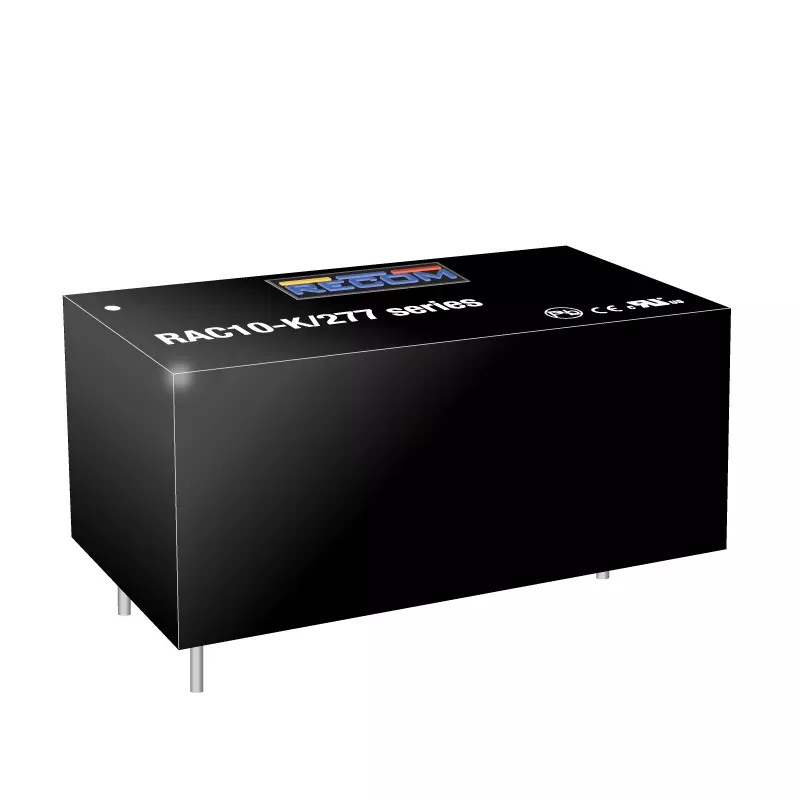
Consider a typical efficiency/load graph for a 10W AC/DC power supply (e.g., RAC10-12SK/277).
The efficiency overload graph is relatively flat for all loads above approximately 20%, which is beneficial. At 50% load (5W), efficiency ranges from 77% to 81% depending on the supply voltage (Figure 1, orange line). At 100% load, efficiency remains constant at 83% regardless of input voltage (Figure 1, blue line). This difference may appear minor, but 77% efficiency means 30% of the supplied energy is lost as heat, whereas 83% efficiency results in only 20% loss—a significant reduction in dissipated power. If the power supply were replaced with an equivalent 5W-rated AC/DC converter, such as the RAC05-K/277, efficiency would be a constant 83%, independent of supply voltage (Figure 2).
The efficiency overload graph is relatively flat for all loads above approximately 20%, which is beneficial. At 50% load (5W), efficiency ranges from 77% to 81% depending on the supply voltage (Figure 1, orange line). At 100% load, efficiency remains constant at 83% regardless of input voltage (Figure 1, blue line). This difference may appear minor, but 77% efficiency means 30% of the supplied energy is lost as heat, whereas 83% efficiency results in only 20% loss—a significant reduction in dissipated power. If the power supply were replaced with an equivalent 5W-rated AC/DC converter, such as the RAC05-K/277, efficiency would be a constant 83%, independent of supply voltage (Figure 2).