Peak Power vs Average Power: How to Choose the Right AC/DC or DC/DC Converter

Power output response over time
Many engineers prefer to choose a power supply with ample headroom. In a worst-case scenario, if the application draws 5W, a 10W power supply will be selected. The rationale is that a certain safety factor is required for maximum reliability and to ensure that future additional features in the application circuit can be supported without exceeding the power converter’s capacity. These are strong arguments, but they do not always represent the most efficient design approach.

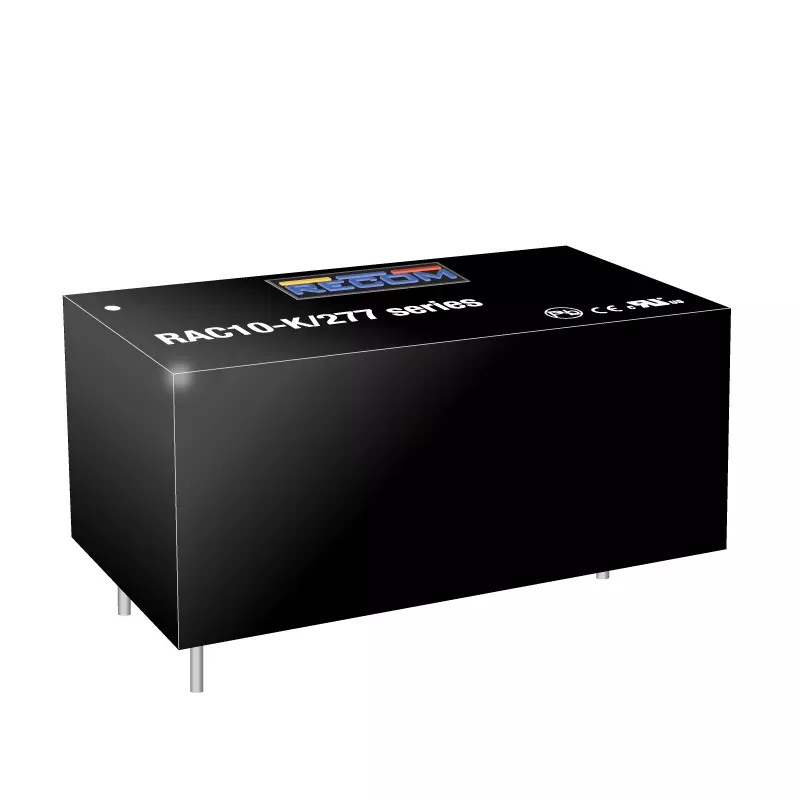
Consider a typical efficiency/load graph for a 10W AC/DC power supply (e.g., RAC10-12SK/277).

The efficiency overload graph is relatively flat for all loads above approximately 20%, which is beneficial. At 50% load (5W), efficiency ranges from 77% to 81% depending on the supply voltage (Figure 1, orange line). At 100% load, efficiency remains constant at 83% regardless of input voltage (Figure 1, blue line). This difference may appear minor, but 77% efficiency means 30% of the supplied energy is lost as heat, whereas 83% efficiency results in only 20% loss—a significant reduction in dissipated power. If the power supply were replaced with an equivalent 5W-rated AC/DC converter, such as the RAC05-K/277, efficiency would be a constant 83%, independent of supply voltage (Figure 2).
Efficiency vs. Load for RAC10-12SK/277
Fig. 1: Efficiency/load graph for a 10W AC/DC converter
Efficiency vs. Load for RAC05-12SK/277
Fig. 2: Efficiency/load graph for a 5W AC/DC converter
Additionally, the 5W part not only operates more efficiently, but its size is almost half that of the 10W part and it is less expensive—a clear advantage.

Peak power vs average power

However, what about peak power? How can a power supply operating under worst-case continuous load also handle short-term peak overloads? The key term is “worst-case.” During normal operation, the load is usually lower than this maximum. If the converter operates continuously at the worst-case load, it can comfortably handle this level, while actual load in practice is often much less. This provides the converter with thermal headroom to manage short-term peak overloads exceeding the continuous operating load.

For example, the RAC05-SK/277 datasheet includes a calculation for peak load capability (Figure 3):
Peak load calculation formula
Fig. 3: Peak load calculation (from datasheet)
An important figure is PP—the peak output power. The RAC05-SK/277 has a nominal output of 5W but can deliver 6W without triggering overload protection.

For overloads under 120% of nominal load, the limiting factor is the internal temperature of the converter components. If sufficient cooling time is allowed between overload events, the converter can withstand multiple or cyclic overloads while maintaining a stable output voltage.

For very short, severe overloads, an external output capacitor can provide the required peak current and prevent the converter from entering overload protection. This is useful in applications such as wireless-connected microcontrollers, where current peaks during transmission bursts are brief but high-power events, while average power consumption remains low (Figure 4). In such cases, the power supply can be sized based on average power rather than peak power.

Power consumption graph over time

Fig. 4: A typical current consumption profile for a WLAN-enabled microcontroller

So far, we have considered AC/DC converters, but DC/DC converters can be analyzed similarly. DC/DC converters are designed for continuous operation in the 80–100% output power range, and their efficiency drops more rapidly at lower loads. Therefore, operating a DC/DC converter at low output current does not always reduce temperature significantly. Using a 10W DC/DC converter at a 5W load should generally be avoided unless derating is necessary to meet the operating temperature range.

For example, the RS12-Z series delivers 12W of isolated power in a compact SIP8 case (21.8mm x 9.6mm). With natural convection cooling and a 24V supply, the RS12-Z converter can operate at full power up to 75°C. By derating the load to 50%, it can operate across the industrial range of -40°C to +85°C. Halving the load increases ambient temperature range by only +10°C because the converter is no longer at maximum efficiency. Nevertheless, even 6W in a SIP8 case with full industrial temperature operation and free-air convection cooling outperforms competitors that require forced air cooling for the same output power.

Overcurrent Protection in Power Supplies

Gate drive circuit with transformer and FET
Fig. 5: Simple overcurrent protection. When the voltage across the shunt resistor exceeds 0.7V, the NPN transistor turns on and disables the gate drive to the power FET.
Many cost-effective AC/DC and DC/DC converters include a simple overcurrent protection circuit that monitors voltage across an internal shunt resistor (Figure 5).

These internal protection circuits are simple, effective for short-circuit protection, but have wide overcurrent limit variation due to shunt resistor tolerance and the VBE threshold voltage of the NPN transistor. Component values are set to avoid nuisance triggering across the full ambient temperature range at 100% load. This allows the converter to tolerate up to 140% of nominal output power at room temperature while maintaining reliable full-load operation.

DC/DC switching regulators are an exception, as they often operate at higher switching frequencies to reduce component size (for buck converters, higher frequency reduces both the output inductor and capacitor). They have lower internal power reserves for sudden peak overloads. The shunt resistor is typically integrated on the same IC wafer with tighter tolerance, resulting in less variation in overcurrent limit.

Most switching regulator controllers also use cycle-by-cycle current limit monitoring via precise comparator output rather than relying on VBE threshold voltage. As a result, they shut down almost instantly when overcurrent or short-circuit limits are reached. DC/DC switching regulators should therefore be sized to handle worst-case peak loads rather than average loads.

Conclusion

Over-specifying an AC/DC or DC/DC converter to manage transient peak loads as if they were continuous is inefficient and can lead to unnecessarily large power supplies. Understanding average, worst-case, and peak load conditions of the application allows selection of an optimal power converter that ensures reliable supply voltage at lower cost. Technical support engineers or sales teams can advise on the best solution for your application.
Applications
  Series
1 RECOM | RAC05-K/277 Series | AC/DC, THT, 5W, Single Output
Focus
  • Wide input range 85-305VAC
  • Standby mode optimized (eco design Lot 6)
  • Overvoltage category OVC III (2000m)
  • Operating temperature range: -40°C to +90°C
2 RECOM | RAC10-K/277 Series | AC/DC, THT, 10W
Focus
  • Wide input range 85-305VAC
  • Operating temperature range: -40°C to +80°C
  • High efficiency over entire load range
  • No external components necessary
3 RECOM | RS12-Z Series | DC/DC, THT, 12W, Single Output
Focus
  • 12W in SIP8 package
  • 3kVDC isolation
  • 4:1 input voltage range
  • Operating temperature from -40°C to +75°C with no derating and convection cooling only