Electromagnetic Compatibility (EMC) of equipment encompasses conducted and radiated emissions, susceptibility to conducted voltage disturbances and radiated fields, and immunity to Electrostatic Discharge (ESD). Distortion of AC line current by AC/DC converters is also included. In Europe, the EMC directive 2014/30/EU requires that end equipment meets harmonised standards. In this article, we examine conducted emissions from switched-mode AC/DC and DC/DC converters and how performance can be influenced by filter components.

EMC and EMI Design Strategies for AC/DC and DC/DC Power Supplies
2019. 3. 20

Electromagnetic Interference (EMI) is always a potential challenge with switched-mode power supplies, including both AC/DC and DC/DC converters. Modern designs can achieve strong performance for emissions and immunity, but external connections must still be correctly implemented for optimal results. In some cases, additional noise filtering is necessary to meet specific application requirements. However, improperly designed filters can actually worsen EMI. This article provides guidelines for achieving the best conducted EMI performance from AC/DC and DC/DC converters, including considerations when using external filters.
Table of Contents
High Efficiency Can Increase Noise in Power Supplies
Engineers are familiar with the advantages of switched-mode converters—high efficiency with compact size and low weight—but many have also struggled with the electrical noise they generate. Modern converter designs, however, benefit from improved components and topologies that inherently produce low noise, such as resonant types. Techniques such as frequency dithering further reduce the energy of emissions within a given measurement bandwidth. The source of the noise is the fast switching of semiconductors, with waveform rise and fall times measured in nanoseconds, which is necessary for high efficiency.
The high dV/dt and di/dt levels, however, cannot be fully contained within the converter and can manifest as voltage or current noise spikes conducted along input or output lines. Fourier analysis shows the envelope of emissions from a typical switching waveform in Figure 1, illustrating that as rise/fall times Tr and Tf decrease, the emission bandwidth increases, with overall amplitude affected by the duty cycle of the waveform Ton/Tp [1].

Fig. 1: Envelope of emissions from a switching waveform
The high dV/dt and di/dt levels, however, cannot be fully contained within the converter and can manifest as voltage or current noise spikes conducted along input or output lines. Fourier analysis shows the envelope of emissions from a typical switching waveform in Figure 1, illustrating that as rise/fall times Tr and Tf decrease, the emission bandwidth increases, with overall amplitude affected by the duty cycle of the waveform Ton/Tp [1].

Fig. 1: Envelope of emissions from a switching waveform
Noise Components in AC/DC and DC/DC Converters

Conducted noise exists in two forms, Differential Mode (DM) and Common Mode (CM), which are typically present together at some level. DM noise is measured as a voltage between a power line and its return. CM noise is measured between both power lines and system ground and is usually recorded as a voltage across a defined impedance. This is because power converters tend to act as a current source for CM noise at high frequencies. Figure 2 shows both types diagrammatically.
DM noise is straightforward to measure with an oscilloscope or analyzer, but CM requires a standard termination network, a Line Impedance Stabilisation Network (LISN). This includes the defined termination impedance and filtering necessary to isolate any influence from the upstream power source. The LISN is defined by CISPR standards, typically CISPR 22 for IT equipment, and is intended for AC/DC converter noise measurements, though it is also commonly used with DC/DC converters.
The LISN outputs a weighted combination of DM and CM noise, so that even with no CM noise present, half of the DM noise amplitude is observed. This means that attenuation of both DM and CM noise types is required to meet the limit lines of the CISPR 22 standard and its derivative EN 55022.
DM noise is straightforward to measure with an oscilloscope or analyzer, but CM requires a standard termination network, a Line Impedance Stabilisation Network (LISN). This includes the defined termination impedance and filtering necessary to isolate any influence from the upstream power source. The LISN is defined by CISPR standards, typically CISPR 22 for IT equipment, and is intended for AC/DC converter noise measurements, though it is also commonly used with DC/DC converters.
The LISN outputs a weighted combination of DM and CM noise, so that even with no CM noise present, half of the DM noise amplitude is observed. This means that attenuation of both DM and CM noise types is required to meet the limit lines of the CISPR 22 standard and its derivative EN 55022.
DC/DC Converter Input Filters and Noise Reduction

There is no universal standard for noise emissions from DC/DC converters, as they are typically embedded in systems that must comply with EMC regulations. Board-mount DC/DC manufacturers include at least a parallel input capacitor within the product package, and the resulting noise levels are often fully acceptable. Occasionally, lower noise levels are required, and manufacturers typically recommend adding an external L-C filter to reduce DM noise, as shown with L and C1 in Figure 3.
It may seem beneficial to add large-value components to minimize noise, but this can be counterproductive: large inductances can have high resistance, causing voltage drop and power dissipation. Magnetic saturation with high inductance can be problematic, and low self-resonance may result in ringing and potential overvoltage at the DC/DC input. This effect can even worsen the measured noise spectrum. Figure 4 shows the noise of a sample converter with no filter, with only L and C1 fitted, and then with C2 added, which increases spectrum peaks.
It may seem beneficial to add large-value components to minimize noise, but this can be counterproductive: large inductances can have high resistance, causing voltage drop and power dissipation. Magnetic saturation with high inductance can be problematic, and low self-resonance may result in ringing and potential overvoltage at the DC/DC input. This effect can even worsen the measured noise spectrum. Figure 4 shows the noise of a sample converter with no filter, with only L and C1 fitted, and then with C2 added, which increases spectrum peaks.

Fig. 4: Extra filter components can actually make EMI worse
Another potential issue is instability of the converter control loop. This occurs when the output impedance of the filter at its resonant frequency is close to the input impedance of the DC/DC converter (which is incrementally negative—input current decreases as input voltage increases). Middlebrook [2] investigated this effect and concluded that the output impedance of the input filter must be much lower than the input impedance of the converter. This can be achieved with an additional damping circuit, R and C5, in Figure 3. C5 is >>5 × C2, which may be internal to the DC/DC, and R = √(L/C2). Alternatively, a lossy electrolytic capacitor provides a similar effect, though its capacitance and loss resistance are less tightly controlled.
CM noise is often negligible with DC/DC converters when both input and output are grounded. If the input is floating, capacitors C3 and C4 can be added to reduce CM noise. However, capacitance may be limited if the converter forms part of a safety barrier to high-voltage AC. C3 and C4 then determine the maximum allowable AC leakage current and must be Y-rated with the appropriate transient voltage rating. In extreme cases, two capacitors in series may be required for highly sensitive applications, such as patient-connected medical devices, in case one capacitor fails short.
In some applications, voltage transient suppression may be necessary at the DC/DC converter input. Certain standards for transient levels exist, for example in automotive and rail industries, but levels are less well-defined in other applications. The recent EN IEC 61204-3:2018 ‘Low voltage switch mode power supplies - Part 3: Electromagnetic Compatibility’ is not yet widely adopted but defines overvoltage levels for different DC/DC converter application categories.
AC/DC Converter Input Filters and EMC Compliance
The situation with AC/DC converters is generally simpler. For high-power products, there is usually a direct connection to the AC mains. The converter must comply with the EMC directive and typically includes an internal filter suitable for the intended application: industrial, IT, medical, test equipment, etc. However, board-mounted AC/DC converters that connect to AC mains via internal tracks and wiring are widely used.
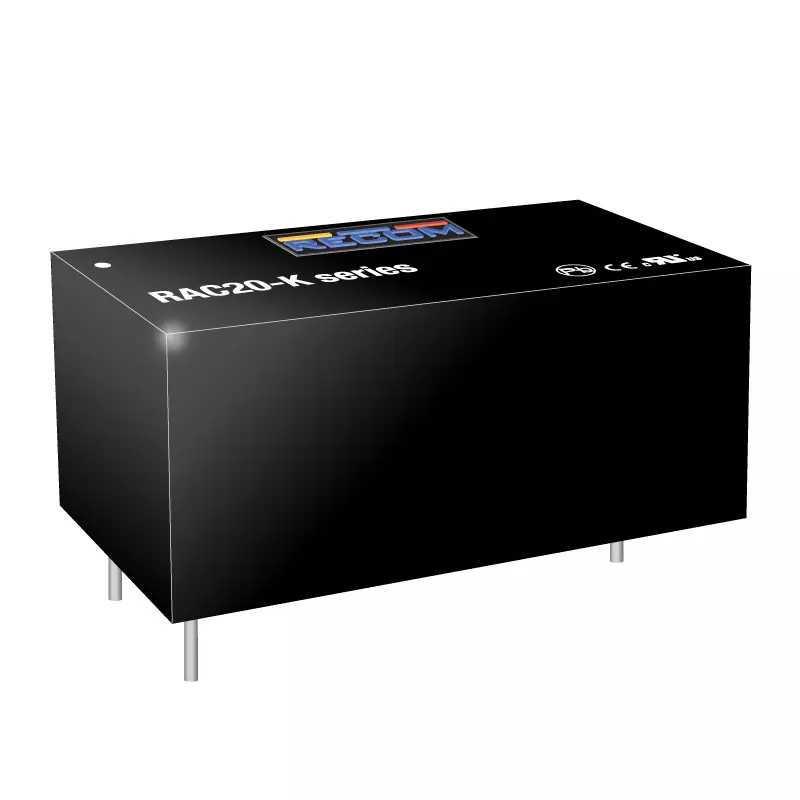
These converters often include internal filtering to meet the highest EMC emissions standards (Class B), such as the RECOM RAC20-K series, but some products meet the lower Class A limit, which can reduce costs if AC is already filtered elsewhere in the system. Manufacturers may recommend external filter components to achieve Class B compliance, typically an X-rated capacitor across the AC line and Y capacitors from both AC lines to ground. The RECOM RAC03-GA series is an example.
For effective performance, these components should be placed very close to the converter with a direct, low-impedance connection to ground. There are limits to allowable values: for example, X capacitors must discharge to a safe voltage, typically within one second of disconnecting AC mains, and may require a parallel discharge resistor of suitable rating. As with DC/DC converters, Y capacitors must not allow dangerous leakage currents if the system ground becomes disconnected. Maximum current can be as low as 10µA for sensitive medical applications, limiting capacitor values to approximately 100pF. Other applications, such as IT, allow higher leakage currents, up to 3.5mA, permitting larger Y capacitor values.
System EMC performance cannot be easily predicted from the performance of individual components. Compliant board-mount AC/DC converters cannot guarantee a system pass. Manufacturers such as RECOM, offering a wide range of system and board-mount power supply products, provide in-house EMC test facilities to assist customers with pre-compliance testing.
These converters often include internal filtering to meet the highest EMC emissions standards (Class B), such as the RECOM RAC20-K series, but some products meet the lower Class A limit, which can reduce costs if AC is already filtered elsewhere in the system. Manufacturers may recommend external filter components to achieve Class B compliance, typically an X-rated capacitor across the AC line and Y capacitors from both AC lines to ground. The RECOM RAC03-GA series is an example.
For effective performance, these components should be placed very close to the converter with a direct, low-impedance connection to ground. There are limits to allowable values: for example, X capacitors must discharge to a safe voltage, typically within one second of disconnecting AC mains, and may require a parallel discharge resistor of suitable rating. As with DC/DC converters, Y capacitors must not allow dangerous leakage currents if the system ground becomes disconnected. Maximum current can be as low as 10µA for sensitive medical applications, limiting capacitor values to approximately 100pF. Other applications, such as IT, allow higher leakage currents, up to 3.5mA, permitting larger Y capacitor values.
System EMC performance cannot be easily predicted from the performance of individual components. Compliant board-mount AC/DC converters cannot guarantee a system pass. Manufacturers such as RECOM, offering a wide range of system and board-mount power supply products, provide in-house EMC test facilities to assist customers with pre-compliance testing.
References
[1] http://www.smps.us/Unitrode.html
[2] Middlebrook, R. D., Design Techniques for Preventing Input-Filter Oscillations in Switched-Mode Regulators, Proceedings of PowerCon 5, the Fifth National Solid-State Power Conversion Conference, May 4-6, 1978, San Francisco, CA
[2] Middlebrook, R. D., Design Techniques for Preventing Input-Filter Oscillations in Switched-Mode Regulators, Proceedings of PowerCon 5, the Fifth National Solid-State Power Conversion Conference, May 4-6, 1978, San Francisco, CA
용도